


Innovation is in our DNA
Curiosity about new possibilities is part of who we are. We research, experiment and develop our own technology to transform the way people interact with the digital world.
We believe in the power of ideas: how a simple question can spark a major discovery, and how every breakthrough can open up paths we have yet to imagine.
We don't innovate just to fix what's broken
Every transformation starts with a question: a hypothesis, or the curiosity to explore something we do not yet know.
We have something in common with the alchemists of old, who sought new ways to transform matter. The difference is that our raw material is knowledge, and our laboratory is technology.
We research new artificial intelligence models, advances in computer vision, hardware improvements and biometric techniques to take identity verification one step further.
We observe, experiment, validate our findings and bring the advances that prove their value into our products.
This is how we turn knowledge into technology
- 1
Keeping up with the state of the art
We keep a close eye on academic research, the industry and advances in hardware.
- 2
Researching and experimenting
We test new techniques using our own use cases and data.
- 3
Validating rigorously
We measure real improvements and make sure they meet security standards.
- 4
Turning it into a product
We integrate it into MobbScan, MobbID and MobbSign so our customers can benefit from it.
Our approach has a name of its own
We have developed an ecosystem of solutions that supports people throughout their digital relationship with an organisation: from initial registration to subsequent authentications and digital signing. Three specialised products, connected by the same technological foundation and designed to meet different identification and verification needs.
 1
Registration
We verify identity during in-person or remote onboarding using an identity document and facial biometrics.
MobbScan 2
Authentication
We reuse those biometrics for subsequent authentication in payments, app or physical access, or as a second factor.
MobbID 3
Signing
Customers can sign documents and contracts, including with a handwritten biometric signature.
MobbSign
Years of research have enabled us to build technology that evolves with us
We develop our own biometrics and document verification algorithms. This allows us to retain control of our technology, continuously improve it and adapt it to the requirements of each project.
Hover over each step to see which technologies are involved
- Facial recognition
- Voice recognition
- Liveness detection
- Biometric signature
- Advanced OCR for identity documents
- Reading and validation of documents using NFC
- Module for fraud detection
- Forensic analysis of images
From traditional attacks to the threats posed by generative AI
Identity fraud evolves alongside technology. We study every new impersonation technique to develop countermeasures that can anticipate threats and help create safer digital environments.
- Printed photographs
- Screen replay
- Masks and replicas
- Altered documents
- Deepfakes and synthetic faces
- Video injection
- Cloned voice
Images
Manipulated photographs, synthetic faces and digitally altered documents, which we detect using image analysis and document fraud detection techniques.
Video
Deepfakes, video replay and injection attacks that use virtual cameras, emulators or tampered applications to introduce fake images into the process.
Voice
Cloned and synthetic voices used to impersonate someone during voice authentication processes.
Liveness detection, forensic analysis of images and documents, and injection attack detection work together to identify different impersonation techniques and protect remote identity verification processes.
Bringing talent, research and technology together
We work with universities on research and development initiatives and programmes that bring university talent closer to the technology sector.
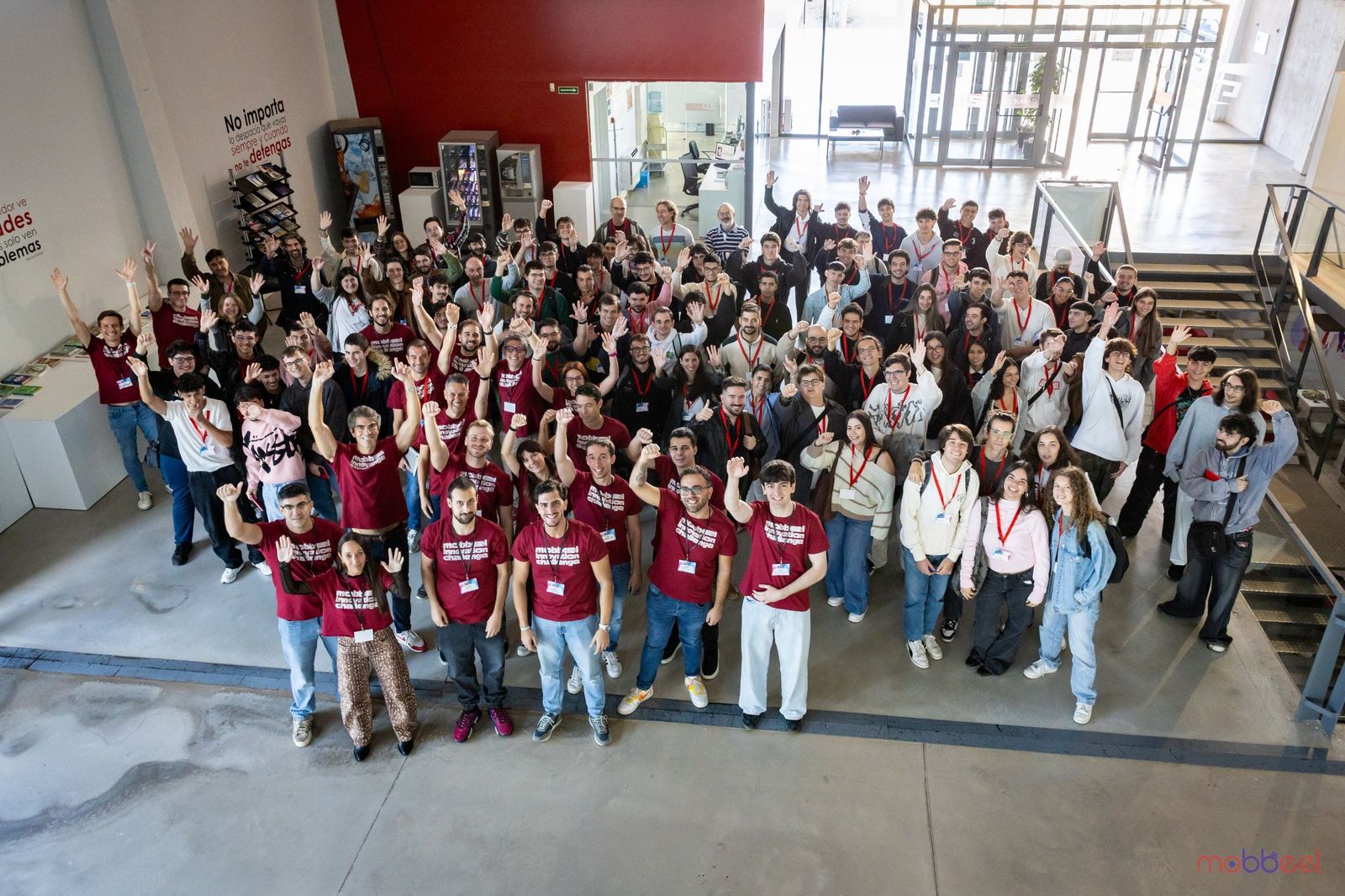
Mobbeel Innovation Challenge
A challenge where teams from inside and outside Mobbeel come up with and build new ideas around digital identity.
Challenges
We put our technology to the test through technology challenges and industry evaluations.
Conferences and talks
We share our expertise at conferences, seminars and specialised events.
Scientific publications
We publish our research findings in collaboration with the academic community.
University
We work with universities on R&D projects and technology talent development.
Dual vocational training
We welcome dual vocational training students, who learn by working on real-world projects.
Formacoex
We take part in training programmes that foster technology talent in Extremadura.
Certified quality and innovation





Projects we have been involved in
RedIA – VIDA Project
Development of digital protection tools against injection attacks on biometric systems
Objective
To develop and improve artificial intelligence-based tools to prevent and detect injection attacks on biometric systems, strengthening the security of digital identity verification processes against increasingly sophisticated fraud techniques.
The project
Mobbeel has received funding from Red.es under the RedIA programme to develop the VIDA project, an initiative aimed at strengthening the security of biometric systems against injection attacks.
These attacks make it possible to introduce manipulated images, videos or AI-generated content directly into the verification flow, without having to present a physical identity document in front of the camera. In response to increasingly sophisticated threats, VIDA aims to advance the development of detection mechanisms that can identify new fraud patterns and strengthen the protection of identity verification processes.
The project takes a multi-layered protection approach that includes:
- New AI models to detect more types of deepfake, including the most sophisticated ones.
- More precise detection of signs of fraudulent origin in biometric samples.
- Stronger encryption and protection throughout the authentication process.
- Advanced fraud detection directly on the capture device.
The aim is to address today’s threats while continuing to develop more secure and resilient digital identity technologies that can respond to the evolution of digital fraud and anticipate emerging threats.
The project was one of 300 selected by Red.es from more than 1,000 submissions. This recognises the technology innovation work we carry out from Cáceres to protect the digital identities of individuals and organisations in more than 30 countries.
Funding
The VIDA project has received funding from the RedIA programme, promoted by Red.es as part of initiatives supporting technological development and innovation in artificial intelligence and other dual-use technologies.
Project co-financed by the European Union through the European Regional Development Fund (ERDF), under the Spain ERDF Multi-Regional Programme 2021–2027.


PIT: Innovation and Talent PLUS Programme (PIT+)
Objective
Through this project, Mobbeel aims to recruit a young professional and provide them with high-value training in identity verification technologies. In collaboration with the University of Extremadura, a programme has been designed that combines additional training to strengthen the selected candidate’s technical skills with practical work on one of the R&D&I department’s workstreams. Specifically, the project aims to overcome a current technological limitation: the difficulty of adding support for new identity documents quickly and easily.
Project co-financed by the European Social Development Fund. A way to build Europe.
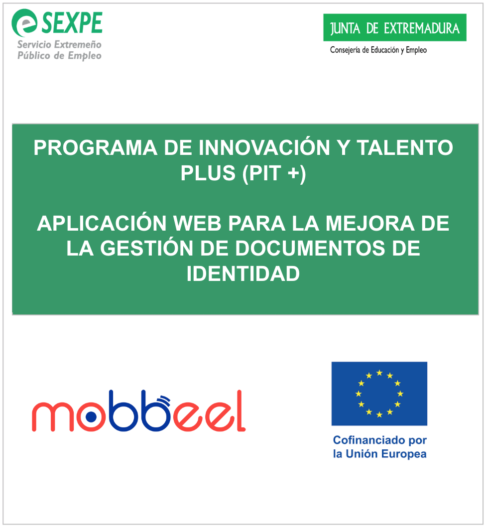


PIT: Innovation and Talent PLUS Programme (PIT+)
Objective
Through this project, Mobbeel aims to recruit a young professional and provide them with high-value training in identity verification technologies. In collaboration with the University of Extremadura, a programme has been designed that combines additional training to strengthen the selected candidate’s technical skills with practical work on one of the R&D&I department’s workstreams. Specifically, the project aims to overcome a current technological limitation: the difficulty of creating personalised onboarding workflows easily, so that the product can be adapted to each customer’s needs. This challenge is highly experimental in nature, as a significant amount of time will be devoted to designing possible alternatives and applying the latest web development trends to find the solution that best meets the requirements set out at the start.
Project co-financed by the European Social Development Fund. A way to build Europe.

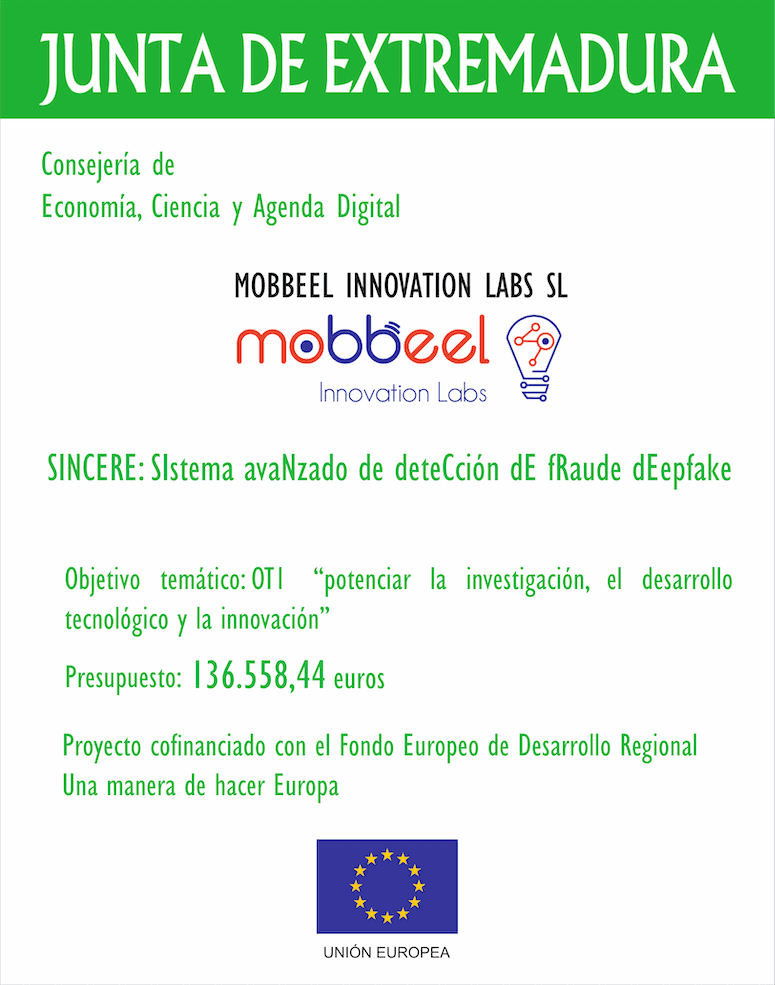
SINCERE: Advanced Deepfake Fraud Detection System
Thematic objective: OTI “promoting research, technological development and innovation”.
Objectives
- Research techniques that enable the development of technologies to effectively combat deepfake fraud.
- Use the research findings to improve Mobbeel products, enabling them to robustly address upcoming challenges to biometric security.
- Establish Mobbeel as a leading company in the global biometrics market and strengthen its competitiveness.
- Continue to foster a company culture built on research as the foundation for continuous innovation, while developing employees’ knowledge and skills.
- Promote a high-value-added economy by creating and sustaining technology-sector job opportunities in Extremadura, in line with regional, national and European strategic objectives.
Project co-financed by the European Social Development Fund. A way to build Europe.
Robust, Highly Scalable Facial Verification
The overall aim of this project is to conceptualise, design and develop a next-generation, integrated expert system for robust, highly scalable facial identification. The technology will be based on the latest advances in artificial intelligence (deep learning) and big data, with the ambition of becoming a benchmark for identity verification systems based on facial analysis in uncontrolled environments.
To achieve this, algorithms will be developed to create robust descriptions of facial features and compare them to identify identity matches. Packaging and deployment mechanisms will also be developed for lightweight, automatically scalable architectures capable of handling high volumes of requests. To meet this overall goal, the project will address five key technological objectives, alongside strategic business objectives that will enable the company to offer the sector a new and innovative solution, expanding its current portfolio of products and services with high added value.
The technological challenge is to overcome the current limitations of facial identity verification systems, making it possible to identify people in databases containing hundreds of thousands of users in uncontrolled environments while keeping response times within commercially viable operating limits—something that is not currently possible. Research and innovation activities will therefore focus on developing the technology needed to achieve this goal, improving existing processes and delivering new solutions.

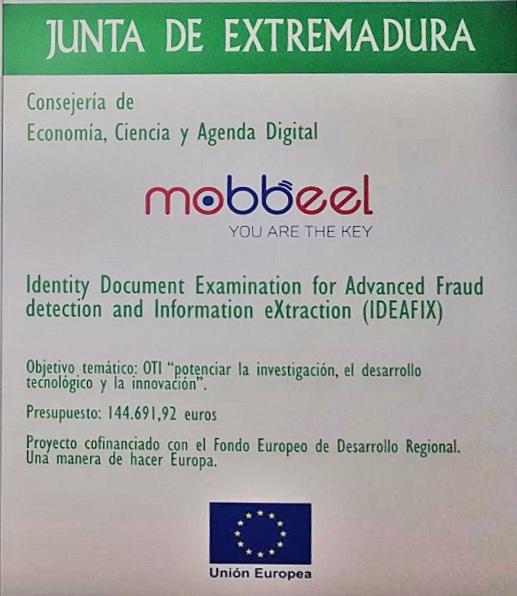
Identity Document Examination for Advanced Fraud Detection and Information eXtraction (IDEAFIX)
Thematic objective: OTI “promoting research, technological development and innovation”.
Objectives
- Research into advanced techniques that improve the security and reliability of both assisted and unassisted digital onboarding processes, overcoming their limitations while meeting regulatory requirements.
- Leverage the latest advances in machine learning to go beyond the minimum requirements set by industry stakeholders and deliver innovative solutions.
- Integrate cutting-edge technologies into Mobbeel products to maintain the competitiveness required in a constantly evolving digital ecosystem.
- Strengthen the role of research and innovation within the company culture.
- Support talent development and make the organisation attractive to specialised professionals by creating high-value-added products.
Project co-financed by the European Social Development Fund. A way to build Europe.
SOCCER: Onboarding through Certified Video Conferencing
The overall aim of the project is to develop a solution that enables customers to complete bank onboarding remotely through certified video.
The project will design the component architecture needed to integrate elements for extracting and processing video sources into the existing onboarding contact centre. It will also research and develop the required facial recognition algorithms and the identity document identification and authentication algorithms needed to identify users through certified video. All components will be validated through the development of a mobile application and a web application.
The project is being carried out by a consortium led by Tecnocom Telecomunicaciones y Energía, S.A., with Mobbeel Solutions S.L.L. and Quobis Networks S.L.U. as the other members. Each company contributes its experience and professional expertise within its respective field.
Project funded by CDTI and supported by the Ministry of Economy, Industry and Competitiveness under the 2016 call for grants to promote regional cooperation in research and development (FEDER INNTERCONECTA Programme).
MobbID Cloud
The project aims to create a cloud-based online biometric authentication platform (Single Sign-On) based on the existing MobbID product. This involves making the necessary adaptations to the current product and developing the new architecture required for this type of solution.
Implementation and certification of the R&D&I standard – UNE 166002:2014
Grants to launch a programme aimed at improving the competitiveness of SMEs in Extremadura. This funding is co-financed by the European Regional Development Fund under Thematic Objective TO3, “Improving SME competitiveness”, through which a grant of €4,797.60 has been awarded.
The project “Implementation and certification of the R&D&I standard – UNE 166002:2014” aims to add value and build trust in the company’s R&D&I activities, enhance its corporate image and competitiveness, create greater value for the organisation and its stakeholders, and strengthen its recognition in the market and society.