
Mobbeel Experiences
Success story

How the University of Murcia digitized its students' identity
Digital onboarding at the University of Murcia makes it possible to verify the identity of students, staff, and collaborators remotely, securely, and efficiently.
A digital identity solution that combines usability, security, and regulatory compliance.
Index
Use this index to navigate the success story:
Importance of the New Regulation
Privacy, Data Protection, and Best Practices
Origin and initial situation
The University of Murcia is a public higher education institution with a long history and a strong international outlook. Its main activities are those typical of any university, notably research, teaching, knowledge transfer and public outreach, always with the aim of applying processes of innovation and continuous improvement.
As with many academic institutions, until relatively recently it relied on a traditional system of identity verification and user registration based on shared passwords and one-time codes. This model required users to travel in person to the university to complete the procedures needed to obtain their access credentials.
This in-person procedure presented significant drawbacks, heightened by several key factors that have highlighted the need for a transformation:
- The COVID-19 pandemic made clear that university administrative activity could not depend on physical attendance, and that remote registration procedures were needed.
- The university’s growing internationalisation. There are increasingly more master’s degrees, online courses and hybrid teaching models that do not require physical attendance: students who do not live in Spain, students who may at any given time be in another autonomous region, and the growing weight of Erasmus students in the university’s day-to-day internationalisation.
- Groups with occasional links to the university. Students on short courses or language courses, or external collaborators linked to one-off services, who likewise did not need to travel to a university site solely to obtain their credentials.
These challenges drove the creation of a new project within the university’s 2025 ICT project portfolio, aimed at developing a digital onboarding system that would allow users to register remotely and securely, with the same guarantees as in-person

Importance of the new regulation
One of the major milestones that enabled the implementation of the digital onboarding project at the University of Murcia was the update of the internal regulations governing the university’s electronic identification system. Until then, identification processes were limited to in-person methods and did not include remote mechanisms, which posed an obstacle to advancing the digitalisation of university services.
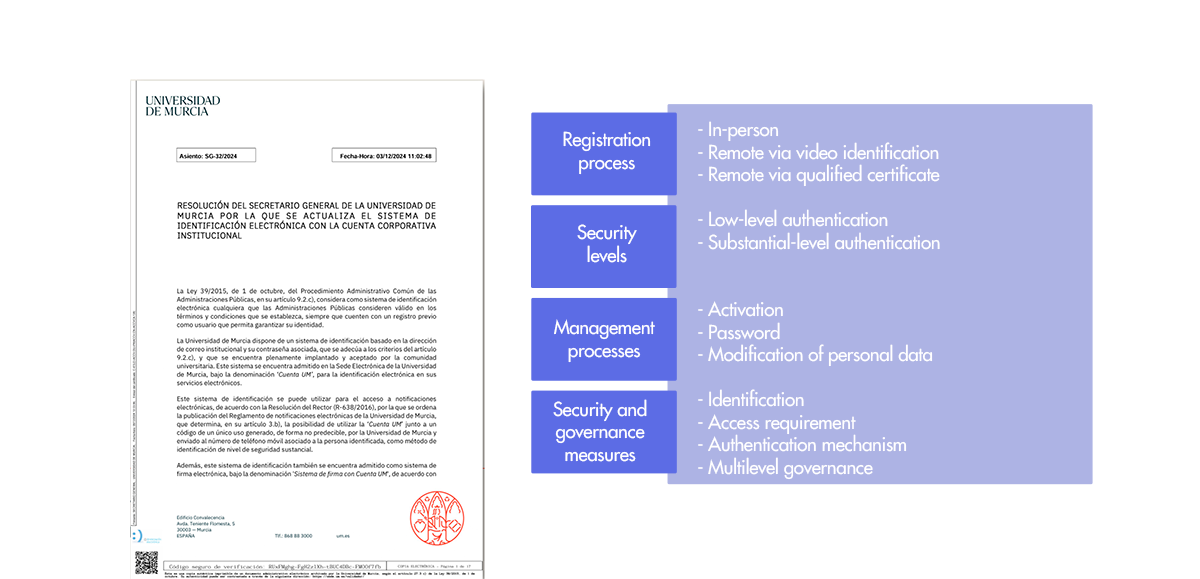
With the publication of Resolution SG-30/2024, the university incorporated video identification as a valid user registration method. This resolution expanded the previous framework by recognising remote registration via video identification as a valid identification mechanism.
Furthermore, the regulation addressed key aspects to ensure the security and governance of the process, such as:
- Authentication levels (low and substantial).
- Processes for account activation, password management, modification of personal data, and account deactivation.
- Access requirements and multilevel security and governance measures.
This regulatory update was essential to legitimise the implementation of video identification, ensuring that remote procedures offered the same level of reliability and security as in-person ones.
Solution: Digital onboarding
To address the challenge of remote registration and verify users‘ digital identity, the University of Murcia carried out a supplier selection process that culminated in the recruitment of MobbScan, the digital onboarding solution developed by Mobbeel. The choice of this technology was mainly due to two decisive criteria:
- Security. MobbScan holds National Security Framework (ENS) certification at the high level, a requirement to which the university, itself ENS-certified for years, attaches great priority. In addition, the product is listed in the catalogue of security products and services of the National Cryptologic Centre (CCN), which was not a strict regulatory requirement but provided a highly valued additional assurance.
- Functional capability, user experience and integration. The university needed a tool that could be incorporated smoothly into the business processes already in place for the UM Account, without remaining an isolated element requiring extra steps outside the flow, but instead fully integrated into the university’s defined registration workflow.
“We needed something that could be incorporated smoothly into our business processes, the ones we already had in place for our UM Account, and that would not be an isolated element. We were looking for something fully integrated into a university workflow that we had defined for registering users.”
— Daniel Sánchez Martínez, Head of Digital Administration Service
Among the main features of MobbScan are:
- Validation of national and foreign identity documents.
- Facial biometrics to ensure the user matches the image on the document.
- Artificial intelligence for detecting fraud attempts or impersonation.
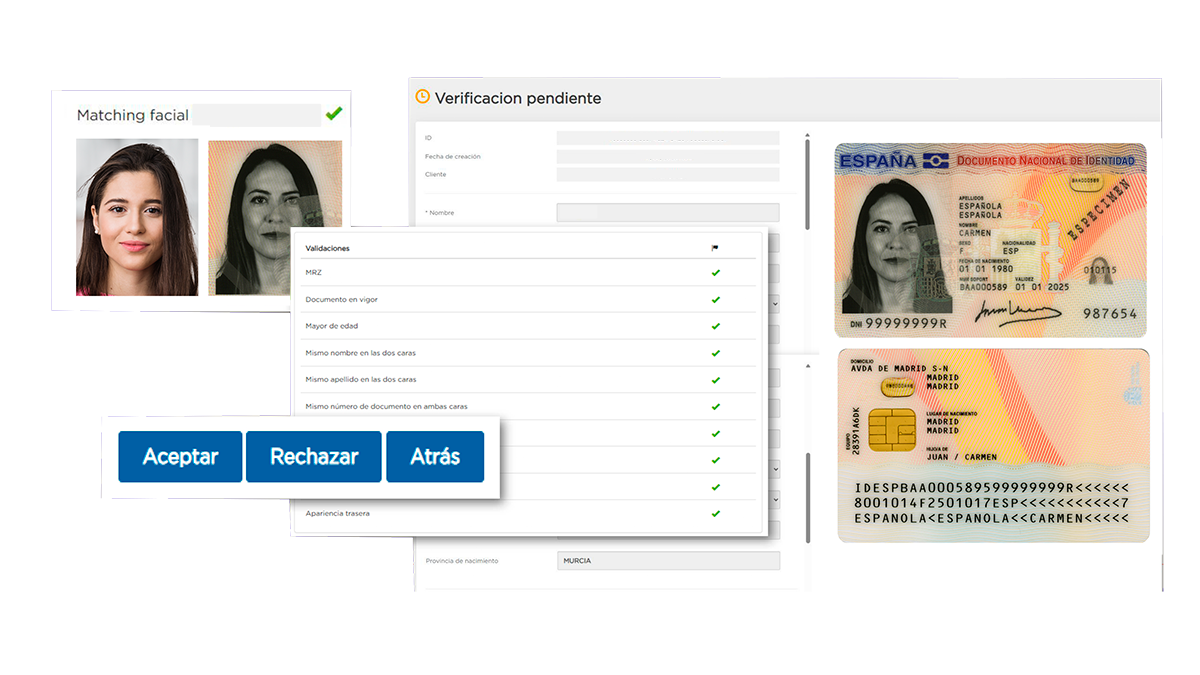
- Web portal for the manual review and validation of processes that require it.
The integration of MobbScan into the university’s electronic office was an essential step in ensuring a smooth and accessible user experience.
Digital onboarding journey
The video identification technology implemented through MobbScan allows the University of Murcia to carry out remote user registration with the highest guarantees of security and reliability. The process is integrated directly into the university’s electronic headquarters and consists of several phases that ensure both proper user identification and the validity of the information provided.
The workflow is as follows:
-
- Access to the service: The user accesses the digital onboarding procedure from the electronic headquarters and accepts the terms of use of the service.
- Basic data verification: The system requests the user’s email address and mobile phone number, which are verified through confirmation codes.
- Selection and capture of documents: The user selects the type of identity document to be used and captures images of it, first on the front side and then on the back.
- Video selfie and liveness check: The system asks the user to record a short video and take a selfie. Facial biometric technology then verifies the match between the captured image and the photo on the identity document, ensuring the user’s authenticity.
- Automatic verification: The MobbScan solution performs a set of automatic checks, such as matching data on the front and back of the document, image clarity, and biometric match.
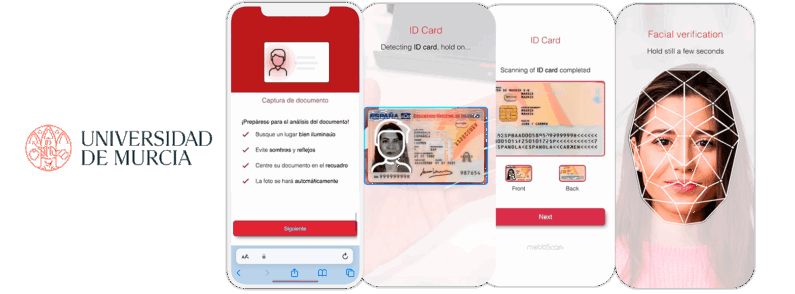
- Confirmation by the user: Before closing the process, the user is shown a final screen with the data collected so they can review and confirm its accuracy.
- Three possible outcomes:
- Successful automatic validation: The process is completed, and access credentials are created for the user.
- Manual review by an agent: If the result falls within a doubtful range, an authorized agent manually reviews the collected evidence.
- Automatic rejection: If the system determines that the minimum reliability thresholds are not met, the process is rejected.
- Account activation: In the case of successful validation, the user receives an email with a link to activate their account for access to university services. If the process fails, the user has the opportunity to try again.

KPI and achieved outcomes
Download the full success story in PDF format and learn about the project’s key indicators.
KPI and achieved outcomes
Download the full success story in PDF format and learn about the project’s key indicators.
Benefits
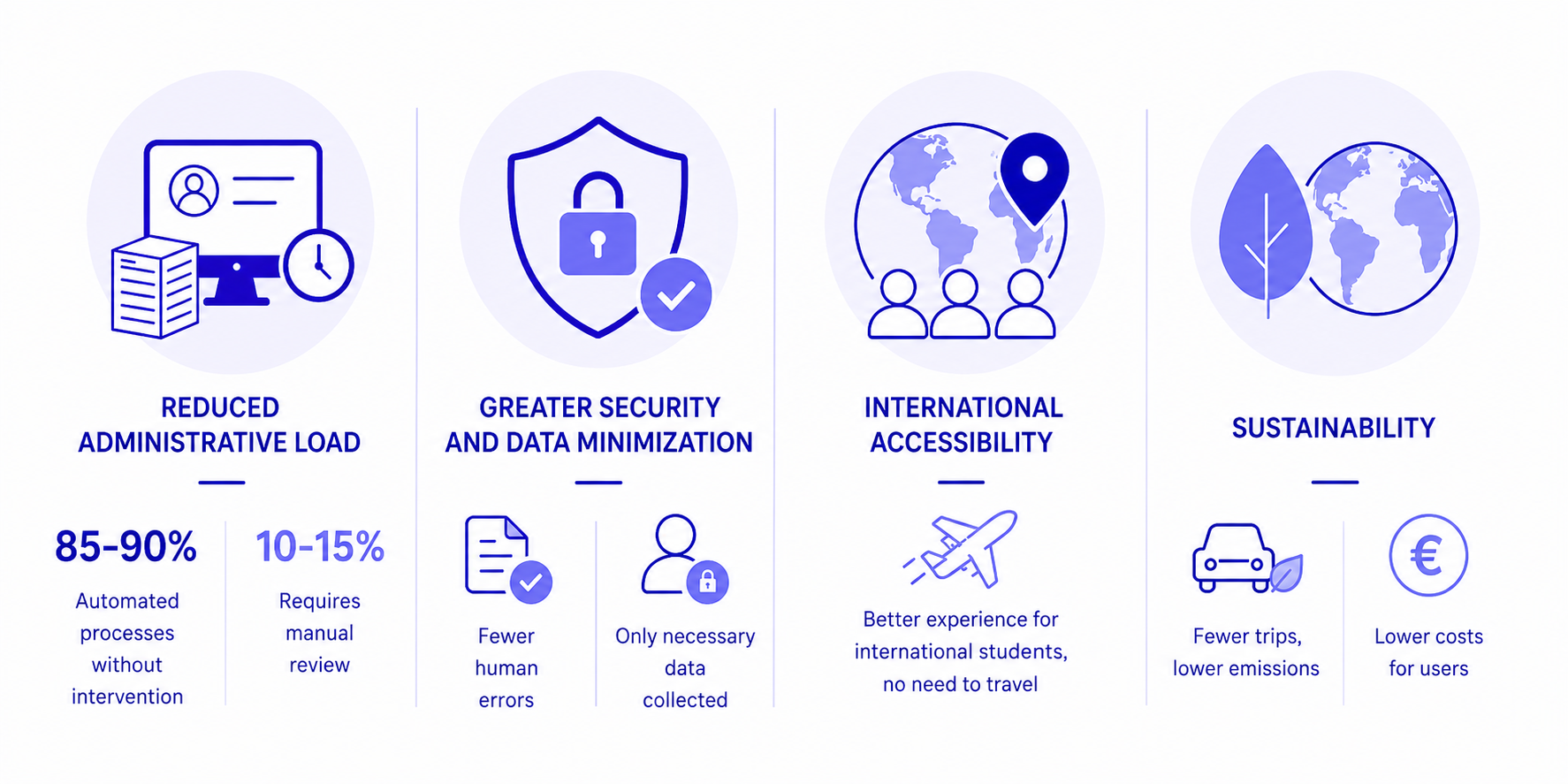
Beyond the obvious benefit of turning an in-person procedure into a remote one, the implementation has also made it possible to identify additional benefits:
- Reduced internal administrative burden: In-person procedures required maintaining multiple service points, checking documentation manually (with the associated risk of human error), and managing appointment-booking systems. Based on experience gathered so far, between 85% and 90% of processes are completed entirely automatically, with no staff involved, and only between 10% and 15% require manual review.
- Greater security and data minimisation: The technology reduces the human error inherent in manual document review and, in many cases, avoids the need to request photocopies of identity documents or other documentation that used to be requested by default, thereby reinforcing the principle of data minimisation. Sensitive information is not stored for longer than necessary, nor on more platforms than necessary.
- International accessibility: The biggest problem the university faced before this solution was precisely that of international students. Remote onboarding represents a decisive step in the internationalisation strategy, improving their experience without requiring physical presence in Spain.
- Sustainability: By avoiding travel, emissions and costs for users are reduced. This is an indirect effect, but a significant one when scaled up to the thousands of students who enrol at the university each year.
Privacy, data protection, and best practices
Since the start of the project, the University of Murcia has placed particular emphasis on ensuring the privacy and protection of the personal data of users involved in the digital onboarding process. To this end, the university has worked in coordination with the Secretary General’s Office and the Data Protection Officer, ensuring that every phase of the project complied with the most demanding legal and security standards.
One of the main instruments in this protection strategy has been the completion of a Data Protection Impact Assessment (DPIA), which has made it possible to:
- Assess the lawfulness and proportionality of the processing of biometric and personal data.
- Confirm that the use of biometrics for remote verification was the approach that guaranteed equivalence with physical presence, ensuring the legitimacy of the processing.
- Verify that an appropriate legal basis always existed: the user’s explicit consent, or the existence of alternative methods such as the use of electronic certificates or the possibility of attending the university in person.
- Review the risk levels and the technical and organisational measures put in place to mitigate those risks.
The key to the project’s legal defence is that the proposed solution is fit for purpose, because it solves the problem at hand, and is proportionate, because it is never compulsory for the student or user, who always has alternatives: physical presence or the use of other existing official identification systems, such as the electronic certificate or Cl@ve.
The university has also taken into account the best practices set out in regulations and sector recommendations, such as those of the National Security Framework (ENS) or those issued by competent authorities on digital identity and data protection. Thanks to this, the digital onboarding solution relies on a certified provider (Mobbeel) that meets recognised security standards, such as the ENS high level.
In addition, measures have been taken to ensure multi-level governance and transparency in data processing, guaranteeing users effective control over their information and their rights.
This combination of legal, organisational and technological measures strengthens confidence in the digital onboarding system and ensures that it meets the highest privacy and security standards required for a remote identification solution in the university setting.
Explanation of which services are being used, roadmap and future uses
The project followed a series of pilots between late 2024 and throughout 2025, always carried out in real, not simulated, scenarios, limiting only the volume or the trial period.
The use cases included, among others:
- Enrolment in language courses and exams, with good results from the very first moment.
- Transfer of academic records to other universities.
- Enrolment in the university’s own qualifications and official master’s programmes, especially in online programmes with a strong presence of international students.
- Doctoral courses, where the particular circumstances of international students were also tested intensively.
- University entrance examinations (PAU), including the identification of external collaborators, examiners and support staff for students with special needs, who, belonging to other organisations, likewise required identification with guarantees.
2026 marks a step change in scale. The goal for the year is to roll the digital process out to all of the university’s registration and enrolment processes.
In mid-July 2026, undergraduate enrolment began, using digital onboarding and video identification, described by Daniel Sánchez Martínez, Head of Digital Administration Service at the University of Murcia, as “the most sensitive process at the university”.
Over the rest of the year, the process will also be rolled out to the university’s other own qualifications, with the aim of ending 2026 with full implementation across all processes requiring user registration, always maintaining the dual option of remote or in-person.
Roadmap
Looking ahead to the coming months, the university has identified new possibilities for using the technology beyond initial registration:
- Credential recovery for users who have lost their usual means of access (mobile phone or electronic certificate).
- Updating of older accounts that did not have complete security information when they were first created.
- One-off identity revalidation in specific situations requiring an additional guarantee.
- Extension of video identification to the admission processes for exchange students, with registration prior to their arrival in Spain.
These possibilities show that the technology implemented has not only met the need to register new users remotely, but also opens the door to a more secure, flexible model of digital identity and credential management at the university, adapted to its changing needs.
High impact on society
At Mobbeel, we understand that technology should not only address technical or business needs but also contribute to the well-being of society. The digital onboarding project developed in collaboration with the University of Murcia is a clear example of how innovation can make people’s lives easier and create a positive impact beyond the boundaries of an organization.
Our video identification solution allows students, professionals, and citizens to access university services quickly and securely, eliminating geographical barriers and reducing the need for in-person procedures. This not only represents progress in terms of efficiency and convenience but also expands educational and personal development opportunities for groups that may have previously faced difficulties accessing these resources.
The University of Murcia’s commitment to responsible digitalisation and its trust in MobbScan strengthens our dedication to creating solutions that improve people’s lives and enhance the relationship between institutions and society.
Our team continues to work to ensure that technology remains a driving force for progress, change, accessibility, and inclusion.

Discover the experience of the Universidad de Murcia
How the University of Murcia has digitalized student identity
Discover the full interview with Daniel Sánchez Martínez, Head of Digital Administration Services at the University of Murcia, and learn how they have approached the digitalization of their identification, enrollment, and registration processes through digital onboarding and video identification.
Want to learn EVERYTHING about the project? Download the PDF with the complete success story.
- How the regulatory update enabled the implementation of video identification.
- The implemented solution and why Mobbeel was chosen as their technology partner.
- Services are already using this technology and the university roadmap for its progressive rollout.
- The importance of privacy and how the university and Mobbeel worked together to meet data protection and governance requirements.
- And as a bonus: the most relevant KPIs obtained in the first months of use and how this data is helping the university plan the system’s expansion.